Showing posts with label draft. Show all posts

Wednesday, November 2, 2022

IWSG & NaNo

The Insecure Writer's Support Group is the brainchild of Alex J. Cavanaugh. He, his clones, minions, friends, and fellow authors make it an amazing event every month.


IWSG badge

Purpose: To share and encourage. Writers can express doubts and concerns without fear of appearing foolish or weak. Those who have been through the fire can offer assistance and guidance. It’s a safe haven for insecure writers of all kinds!  

November 2 question - November is National Novel Writing Month. Have you ever participated? If not, why not?

I LOVE NaNo!

WAY back when I first stumbled into writing for fun (at that point I had no actual knowledge of the publishing biz) I learned about NaNo. Sounded like fun so I jumped in. This was on November 1st.

I started a new project and won. My prize? A rambling mess of a story that required a ton of edits! I learned so much from writing that mess.

Since then, I've done NaNo fairly regularly. Now, I have a much better idea of how I write a story, and my projects no longer require all those edits. I still don't outline or plot in advance, but the characters and main points of a story percolate in my brain long before I start chapter 1.

We all have different ways of writing a story, so the NaNo experience might not be for everyone, but it makes me happy. NaNo is all about the joy of a community focused on writing. As part of the IWSG, we all know something about that!

How about you? Do you NaNo? Are you a rebel?

If you want a NaNo buddy, I'm @jemifraser over there!

Wednesday, May 4, 2022

IWSG & The Best of Times

The Insecure Writer's Support Group is the brainchild of Alex J. Cavanaugh. He, his clones, minions, friends, and fellow authors make it an amazing event every month.


IWSG badge

Purpose: To share and encourage. Writers can express doubts and concerns without fear of appearing foolish or weak. Those who have been through the fire can offer assistance and guidance. It’s a safe haven for insecure writers of all kinds!    

May 4 question - It's the best of times; it's the worst of times. What are your writer highs (the good times)? And what are your writer lows (the crappy times)?

So many good times!!

  • drafting - love the first draft!
  • "planning" out a new series and getting to create a whole new world
  • getting to know characters and their stories
  • connecting the new books to older characters and stories
  • writing those scenes that make me smile all the way through
  • epilogues - where there's no stress and all the warm fuzzies I want
  • 5 star reviews 😊
  • happy repeat readers & reviewers
  • emails from readers who love the books

And a few bad times to keep it real

  • writing those crisis scenes - it sometimes takes me days to work up to it. I don't like when things are scary and stressful for my characters
  • feeling like I should be doing more in the marketing department (to be clear, this is likely never going to happen)
  • um...I think that's it???

Overall, the scale tips hard toward the good side. Otherwise, I would be doing something else!

I love writing and creating. I love interacting with other writers. I love learning more about the craft. I even enjoy most of the business side of things (I do love my spreadsheets and learning new things!). I think my bouncy brain is an asset for this indie author business.

How about you? What do you love about writing?

May the Fourth be with you today and always!

Speaking of the best of times...

The release day for Built Of Secrets is sneaking up. May 16th!

This is the 1st book in a new series - Small Town Heroes. The books are small-town romantic suspense with all the feels!


She’s got a secret… Okay, she’s got several… But only one could get her killed. 

Humiliated after being duped by her ex, Tansy chooses flight over fight. An inherited fishing lodge she can pull off the grid while working on her tech is the perfect hideout. 

Burned-out FBI agent, Sam is worried about his best friend’s little sister. After a devastating case, he heads to Vermont to check on her. And if he happens to get her to fall in love with him? Even better. 

When the ex refuses to stay in the past, Sam knows he’ll do anything to keep her safe. Will it be enough?

Preorder your copy today!

Wednesday, June 2, 2021

IWSG & Marinating Stories

The Insecure Writer's Support Group is the brainchild of Alex J. Cavanaugh. He, his clones, minions, friends, and fellow authors make it an amazing event every month.


IWSG badge

Purpose: To share and encourage. Writers can express doubts and concerns without fear of appearing foolish or weak. Those who have been through the fire can offer assistance and guidance. It’s a safe haven for insecure writers of all kinds! 

June 2 question - For how long do you shelve your first draft, before reading it and re-drafting? Is this dependent on your writing experience and the number of stories/books under your belt?

I NEED some time away from my draft. It has to marinate for a good while (about a month) before I set eyes on it again.

I have a bouncy brain that is often working on (worrying about) multiple stories at a time, so this is pretty easy to do.

At the moment, I have:

  • Bloo Moose #8 - awaiting final polish
  • New series #1 - awaiting a rewrite after a critique on draft 1
  • New series #2 - first draft about 1/2 complete
  • Bloo Moose #9 - making planning notes in Scrivener on plot & characters
Of course, there are also main characters for Bloo Moose #10 and New Series #3 & 4 who are walking around in my head letting me know who they are and what their stories will be about. That doesn't count Future Series characters knocking on my skull.

An author's head is never lonely!!!

So, with my Tigger Brain, I focus on one story's needs at a time. Then while that sits and waits for the next step, I do the next round of work on the next story. That gives me the 3 or 4 weeks I need away from the first story to see it with clearer eyes.

So far, my pattern has been pretty consistent - basically 3 or 4 stories in various stages at a time.

How about you? Do you have a Tigger Brain? Or, does you brain let you focus on one story from start to finish (I can't even imagine how that works!)? Anyone else have a head chock full of characters?

Reaching For Family is up for preorder at most retailers.
Google Play & Eden Books will be up soon!


Jenna learned early that family wasn’t safe. As Bloo Moose’s vet, she’s determined to find her patients loving homes even if she knows the same isn’t possible for her.
 
Noah Washington promised his adoptive parents he’d save their farm and now he’s bought almost all of it back. Only one acre to go but it belongs to a woman who makes his owned guarded heart seem vulnerable.
 
After a decade as an Army Ranger, Noah’s alpaca are supposed to ensure him of a peaceful life but someone is targeting them. Or Jenna. Or him.
 
As the danger escalates, Jenna and Noah build a wary trust, but they’ll need to learn the true meaning of family if they want the farm—and themselves—to survive.

Monday, September 14, 2020

Why I Love Scrivener - Plotting

I'm been asked multiple times about Scrivener and why it works for me, so I thought I'd put together a few posts. Hopefully, they're helpful!

Here are the previous posts:

I don't use the whole range of tools in Scrivener but I've found that MANY of the features really work for my brain. This program has saved my sanity and my stories on many occasions.

When I first started writing, I was a total Pantser (writing by the seat of my pants). I knew the genre I was writing, but that was about it when I started. As you can imagine, this created a need for a LOT of revising and editing. Over time, I decided to learn to plot.

However, most plot books didn't make a lot of sense to my brain. Enter Libbie Hawker's Take Off Your Pants book. Now I have a much better sense of story before I start. I don't feel overwhelmed by the amount of plotting I do and it doesn't suck the joy out of the actual writing for me (which happened with other styles of plotting).

Of course, everyone has to find their own way to plot or not to plot.

When using Scrivener, I always have a folder for Paths. Which is how I think of plotting thanks to Libbie. Each character has their own Path and then I have to combine their paths.


In the screenshot, you'll see the top part of a chart I've created using Libbie's book. It gives me the basics for the character's path. I do one for each character (I have 2 MCs as I write romance with dual pov). Then I need to combine these two paths into one story. And that's where the right-hand side of the screenshot comes in. It bears the fancy title of "Things that need to happen."

I don't have a step-by-step outline. Rather, I have the two paths and the chart of what happens in what order.

Because Scrivener allows that wonderful double writing-space option, I can have either of the Paths or the Combined Path on the screen at the same time as I'm drafting. This helps keep me on track and reminds me where I'm going.

No matter what style of outlining or plotting you do I think you can use Scrivener's double workspace option to your advantage.

How about you? Do you like having your outline visible as you're writing? Anyone else use Take Off Your Pants? Any tips to share?

Monday, August 10, 2020

Why I Love Scrivener - Double Vision


I'm been asked multiple times about Scrivener and why it works for me, so I thought I'd put together a few posts. Hopefully, they're helpful!

The first post on The Basics is here.

I don't use the whole range of tools in Scrivener but I've found that MANY of the features really work for my brain. This program has saved my sanity and my stories on many occasions.

In this post, I'll talk about the physical layout of the Scrivener program. This is probably the main reason I love Scrivener.


Like any word document or writing program, there is a blank space for you to write. In the screenshot above you can see the main writing space is in the middle.

On the left is the Binder. It's the organizer for your project. Each of the arrows shows that there are files or folders within. On the right is the Info section. The small blue icon in the very top left either hides or shows this panel. I generally have this hidden to give me more writing space.

For me, one of the biggest reasons for using Scrivener is that I can have 2 writing spaces open and visible at the same time. If you can see it, in the top right corner of the main writing space above is an icon showing 2 rectangles together. With one click I get this.


As you can see, I've also clicked the blue icon to hide the info panel. If you have notes in there, you might want it open. If you want to label the scenes (pov, settings, point in the novel, first draft...) you'll have to have it open. The tool for that is at the bottom of the Info panel.

There are many reasons I might want 2 writing panels open.

When I'm working on the first draft, I often have the Character's Path section open on the right while I type in the left. This keeps me on track with Goals and Flaws. I might also have the Secondary Characters file open to help me remember the name of the coffee shop baker or the pizza delivery guy.

Drawing of a stick figure hanging from a red heart
(Photo by Nick Fewings on Unsplash)
When I'm revising, I can have Version 1 open in the right panel while I work on Version 2 in the left. That way I can see what the changes look like before I make them permanent. For me, Version 2 is often a complete rewrite. Having the Version 1 file open on the right helps me pick and choose what I want to keep and delete.

I also use the second panel to fact check within the MS. I can easily scroll through to find out what I need to know without losing the place where I'm working.

Sometimes I have the previous scene open on the right to make sure the flow works.

Sometimes I'm skimming through the MS on the left and copy/pasting good Pull/Promo Quotes into the file on the right.

Other times I'm using the research page I've saved into the research file so I don't have Gage fishing for walleyes out of season.

Often I have my To Add, Change, Remove file open on the right while I'm revising on the left.

Or my file of overused words...

So the double writing space feature of Scrivener is probably my favourite feature. What about you? Do you think the double writing space feature would help you? Do you have any other ideas for ways to use that second space?


Monday, July 27, 2020

Why I Love Scrivener - The Basics

I'm been asked multiple times about Scrivener and why it works for me, so I thought I'd put together a few posts. Hopefully, they're helpful!

I don't use the whole range of tools in Scrivener but I've found that MANY of the features really work for my brain. This program has saved my sanity and my stories on many occasions.

When I first tried out Scrivener, I had a completed first draft that needed a lot of work  (rewriting and reorganizing). I tried to copy and paste this story into the program and then rework it from there. This was a big mistake for me. I found the whole thing confusing. But so many people loved the program, I decided to try it for my next fresh story. And this is when I fell in love!

Scrivener is organized into folders and files. These are my organizing units.

Inside my First Draft Folder, I put in another folder for each chapter. Inside each chapter folder are two files. One for the scene from the female pov, the other for the male pov.

In the sidebar (called Binder), I can right-click and change the names of both the files
and folders. I use titles for my chapters (in this case hashtags), so I put these right in the binder. I don't use titles for scenes, so instead, I put brief reminders of what the scene contains (ditch, anderson, lesson...). This makes it incredibly easy to find the right scene when I want to double-check on something or when I want to revise/edit.

The screenshot shows a glimpse of the binder for Reaching For Normal. You can see that each scene also has a coloured dot. That dot tells me quickly whether the scene is from Myla's or Sawyer's pov. Yes, the colours are stereotypical but it's just a reference.

You can change the colours and the reasons for the dots. I like them for pov but you could use them to indicate whether a scene is an action scene or a contemplative scene, set the colours for locations or settings, or whatever you like. It's easy to change the labels and colours.

This screenshot shows the Info section. Well, it's actually called Inspector, but I think of it as Info. The blue button at the top shows/hides it. At the bottom where it shows Myla in pink is where you click to change colours/names for the dots in the above screenshot.

At the top of this screenshot, you can see the index card synopsis of the scene. You can put whatever you like here. I use it for notes on goals for each character, main conflict, stakes for each, and the Cymbal Crash. This is the way the end of the scene hooks the reader to keep reading (a tip from Libbie Hawker's Take Off Your Pants book).

I don't use the Notes section very often, but it's a good place to keep my Add/ Change/ Remove notes as I'm reading through the draft.

I tend to keep these in another file, but I'll get into that and the reasons for it in another post.

At the bottom, you can see No Status. This is for more organized and visual brains than mine.

The small screenshot shows the labels you can attach to your chapter or scene. The Edit button at the bottom allows you to change those labels to whatever you'd like. This can be colour-coded as well.

How about you? Do you use writing software or word documents? Can you think of any other uses for the colour coding? Any requests for topics within Scrivener for me to discuss?


Wednesday, April 4, 2018

IWSG & Perseverance

The Insecure Writer's Support Group is the brainchild of Alex J. Cavanaugh. He, his clones, minions, friends, and fellow authors make it an amazing event every month.


Purpose: To share and encourage. Writers can express doubts and concerns without fear of appearing foolish or weak. Those who have been through the fire can offer assistance and guidance. It’s a safe haven for insecure writers of all kinds!

And we’re revving up IWSG Day to make it more fun and interactive! Every month, we'll announce a question that members can answer in their IWSG Day post. These questions may prompt you to share advice, insight, a personal experience or story. Include your answer to the question in your IWSG post or let it inspire your post if you are struggling with something to say.

April 4 question - When your writing life is a bit cloudy or filled with rain, what do you do to dig down and keep on writing?

Great question!

Life is full of ups, downs, and more bumps in the road than springtime roads here in Canada where potholes proliferate more often than bunnies.

Because of this, there are times when my life is overwhelming and that is what bogs down my writing. But, writing is part of what gives me solace and hope, so I will always write.

To dig myself out of the dumpy days, I tend to switch projects. Because of my Tigger brain, I generally have a minimum of 3 projects on the go. One fiction first draft, one (or three) in various stages of revision, and one non-fiction project. Switching to a different project or even to a different part of the process always gives me that required boost.

How about you? How do you keep going?

Wednesday, August 3, 2016

IWSG & Star Trek & Floppy Disks


The Insecure Writer's Support Group is the brainchild of Alex J. Cavanaugh. He, his clones, minions, friends, and fellow authors make it an amazing event every month.

Purpose: To share and encourage. Writers can express doubts and concerns without fear of appearing foolish or weak. Those who have been through the fire can offer assistance and guidance. It’s a safe haven for insecure writers of all kinds!


And we’re revving up IWSG Day to make it more fun and interactive! Every month, we'll announce a question that members can answer in their IWSG Day post. These questions may prompt you to share advice, insight, a personal experience or story. Include your answer to the question in your IWSG post or let it inspire your post if you are struggling with something to say. 

AUGUST 03rd QUESTION: What was your very first piece of writing as an aspiring writer? Where is it now? Collecting dust or has it been published?

Okay, let's see..

I think this piece would count...

A long, long time ago, when the kids were still very young, I wrote a Star Trek TNG novel. For years, I'd been making Star Trek scripts in my head and I decided to type one out.

I actually don't remember much about it, except:

  • Geordi was the main character of the main plot line
  • The planet involved had no women's rights and some very barbaric customs
  • Geordi got involved with Jaya, a woman from the planet
  • Jaya was very tough, didn't trust easily, and was trying to change her world
  • Jaya was killed at the end
  • A sub-plot involved Deanna using her empathic senses to navigate through an underground prison
  • Deanna and Worf's relationship was developing

That's about it. As far as I remember it was extremely melodramatic and a bit (or a lot!) cheesy. I think it's probably languishing on a floppy disk somewhere. If I find it, I'll have to find a computer with an A drive! 

When I got brave enough to check out a copy of Writer's Digest from the library, I discovered that only "agented submissions" were accepted by the Star Trek people. I had NO idea what that meant, but it sounded very Hollywood-esque. I assumed only famous people had agents.

End of journey.

I knew less than nothing (obviously), but that novel niggled in the back of my head (and my heart) for a lot of years. When I finally decided to actually give this writing thing a go, I already knew I was capable of completing a draft. And THAT is worth something!

How about you? Any fan fiction writers out there? Anyone know what an A drive is? Where's your very first draft?

Monday, January 4, 2016

Editing Tips

Thanks to Ninja Captain Alex J. Cavanaugh, I met a new Twitter Buddy the other day ... Nicole Singer.

That day, Alex posted several of Nicole's links. Some of them were round ups of helpful links, and there was one about editing tips entitled My Favourite Editing Exercises. I'm always looking for Editing tips so I clicked over.

Great tips! The one I put to use immediately was Nicole's suggestion to write
Goal:
Conflict:
Stakes:
at the top of each chapter to let you see at a glance what the chapter is all about.

I never print anything out, so I wondered how to do this effectively. I use Scrivener and I realized I've never used the small Synopsis box in the top right hand corner of the screen for much. The box is there for every single scene, so in each one I plunked in the above with a small alteration...

Goal:
Conflict:
     Heroine:
     Hero:
Stakes:

I used this as I was doing a revising round of my latest story and it really helped me eliminate some extraneous stuff that was bogging down the story. With Scrivener, that synopsis screen is always visible, even as you're scrolling through the screen, so I wasn't able to ignore it!

I'm thinking for the next story I write, I'll use it as a plan for the scene before I write. Who knows? It might even turn me into a plotter! (Don't hold your breath!)

Thanks again, Nicole for the tips, and Alex for the intro!!

How about you? Do you do anything similar with your chapters? What's one of your favourite editing tips?

Monday, December 7, 2015

Kathy Stewart & A Writer's Journey


Please welcome Kathy Stewart to the blog today!
***
A Writer’s Journey
How did your writing journey begin? I’m sure every writer’s tale is different, just as every story we craft has a different twist, an added nuance, even if we’re writing on the same topic. 

I began my journey at the age of eight, when I wrote a Flicka-style novel about a horse called Shadow. I hadn’t read the Flicka series yet, so I thought my book was unique, born out of my passion for horses. 

When I look back now, any self-respecting cowboy would have pulled out his six-shooter and shot poor Shadow – thus ending his career prematurely – because Shadow was not an obedient or easy horse to have around. He bucked, he reared, and threw his rider numerous times. Then he released his corral-mates and led them off to consort with wild mustangs. What a pain he was! And yet he was the hero of my story.

Into my adult years I continued to write articles, short stories and novels, but increasingly found that life got in the way, so these manuscripts never progressed past first-draft stage until we sold our beautiful farm in South Africa and moved to Australia.

Suddenly free of the constraints of a very demanding previous life, I was able to get back to writing in earnest. The result is a number of articles published online and in magazines; short stories that have been shortlisted, some published in anthologies; a book on editing; a children’s book; and two novels. 

In 2010 I was lucky enough to have my manuscripts, the Chameleon Factor and Race Against time, shortlisted and longlisted respectively for the Crime Writers Association Debut Dagger Award.  

This fired my enthusiasm and The Chameleon Factor was later published as Chameleon, a story about a mysterious man who goes missing in 1914, leaving Eve, the girl who loves him, with a decades-long search to discover his whereabouts.

Both Mark of the Leopard and Chameleon are based on fact, derived from true stories that sparked ‘what if?’ questions in my mind. 

And isn’t that how all our journeys begin? That chance word, that chance encounter that sparks the germ of an idea which eventually grows to become your latest novel.

***

Kathy Stewart was born in South Africa, and she and her husband now live on the Gold Coast, Australia. She has published a number of books as well as numerous articles and short stories in magazines and anthologies. Her manuscripts, The Chameleon Factor and Race Against Time, were shortlisted and longlisted respectively for the 2010 Crime Writers Association Debut Dagger Award in the UK.

Kathy Stewart on the web:

Website        Facebook      Twitter       Instagram


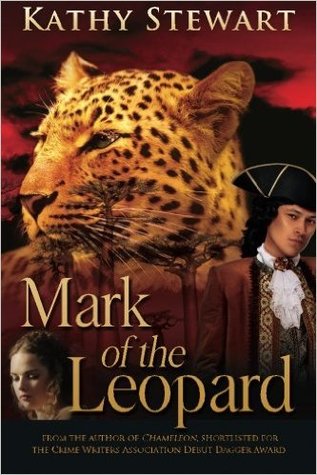
Mark of the Leopard 

From the author of Chameleon comes this historical fiction novel, Mark of the Leopard, the second in the African history series, a story of romance, mystery, danger and betrayal set against a backdrop of wild lands and raging seas. In 1703 Sabrina Barrington and her children are shipwrecked and presumed drowned off the Cape of Good Hope, the site of the present-day city of Cape Town.

Fourteen years later, an investigator tells Sabrina’s brother, Lucien Castle, that one of his sister’s children has been seen on the island of Madagascar, off Africa’s east coast. It is imperative to return the youngster to England before his twenty-fifth birthday, otherwise his grandfather, the corrupt and detested Robert Barrington, will usurp his rightful inheritance.

Castle is the only one who can confirm the young man is not an impostor. In order to do this he must leave the comfort of Amsterdam in Holland and embark on a journey into the unknown. Will Castle be able to overcome his demons and find his nephew in time? Or will he succumb to the perils that beset his epic expedition every step of the way? In a voyage that takes them from the untamed island of Madagascar to the storm-tossed Dutch outpost at the Cape of Good Hope, Castle and his companion must face innumerable dangers and battle not only rival investigators but also each other. 

Buy Links: Amazon Kindle    Amazon Paperback    Amazon UK    B&N     Goodreads


Goodreads Book Giveaway

Mark of the Leopard by Kathy Stewart

Mark of the Leopard

by Kathy Stewart

Giveaway ends December 31, 2015.
See the giveaway details at Goodreads.
Enter Giveaway

Monday, October 19, 2015

Jacqui Jacoby & the 2nd Paragraph

Please welcome Jacqui Jacoby back to the blog today!

***
This week we have author Jacqui Jacoby with a writing craft post of 'Second Paragraph'.

Award-winning author, Jacqui Jacoby lives and writes in the beauty of Northern Arizona. Currently adjusting to being an empty nester with her first grandchild to draw her pictures, Jacqui is a self-defense hobbyist. Having studied martial arts for numerous years she retired in 2006 from the sport, yet still brings strength she learned from the discipline to her heroines. She is a working writer, whose career includes writing books, teaching online and live workshops and penning short nonfiction.


Jacqui Jacoby on the web:

Website           Blog                       Twitter        Facebook

Google + Jacqui Jacoby          Instagram: JacquiJaxJacob      Pinterest: Jacqui Jacoby


Second Paragraph
Every writer faces it.  Every writer worries and dreads that it is going to arrive.  You sit down to type, whether it is a novel, an article or a blog entry, and there it will be: a blank document with a blinking cursor asking you to begin. 

We sit in our chairs, ready to write, the ideas in our head ready to pour onto that page, but we just can’t get it. We can’t get it to sound perfect, moving from our mind to our fingers, even when we think we know what to say.

“Why don’t you just start on the second paragraph,” Lucien Carr said when he at worked at the United Press International, no doubt kick starting a writer at a type writer. And Carr was right. Sometimes skipping the beginning to fill in later and moving on to what comes next is all it might take to get forward momentum.

Hitting a wall of “writer’s block” can be cured by something as simple as Mr. Carr’s suggestion.  You can’t get that first paragraph to work, move down the food chain to the second and see if that doesn’t jump start your ideas.  Sometimes something as simple as going back to write the beginning last can fix the problem.

If hitting the wall, however, turns to jumping off the cliff, then it might take a little bit more creativity to break through.

Ted Schwartz, in his book Time Management for Writers gives excellent advice on multi project.  It is, as Mr. Schwarz says, only writers who set off to work on one solitary project at a time giving it your full interest, until that interest is burned out. “Doctors see several patients. Lawyers see several clients … but writers often believe the myth that they are not being professional unless they stay with one project through to completion …”

Editing a book?  Have you started the research on the next, giving equal time to both projects?  Have you volunteered to guest on a blog? How about your favorite RWA chapter?  I bet the editor of the newsletter would love to have you ask to contribute as well as serving on a board or committee.  Contest judging? Always a fun way to share our creative thinking while helping out while getting a chance to see what other people have to say.

The key to finishing a novel is regularity, to be able to face that first paragraph on a daily basis and say “This is what we’re going to do.”   You must commit to it with a set time and a set goal in order to move from Page One to The End.  Nothing can get in the way of this goal. Not TV programs, telephone calls, requests from family or even that cat who decides your keyboard is the warmest place in the house.  Here is a little known truth: You can move the cat.

On the days the book talks back rudely, telling us “writer’s block” is on the menu, then we need a to attack from a different angle, letting that book know it is going to get written.  We’ll just spend twenty minutes answering writing related e-mail, or maybe we’ll write an entry or our blog.  Or better still … we’ll start on the second paragraph and see what the story has in store for us.

 Jacqui Jacoby's newest release is MAGIC MAN


Detective Peter Mackenzie knew crime and knew his job. With The Cemetery Man schedule to leave the next body on the next grave Peter doesn’t have time for the puzzling Alexandra Madison. Her wild stories of a stolen life and family and friends who don’t remember her. Her last resort, she tells him is him and the relationship they shared. Peter doesn’t need this nonsense and his eccentric father walking in only irritates him more. Until his father utters the name everyone forgot, giving hope to Alexandra for the first time. 

Time is their enemy as the weekend grows closer and on Sunday, Peter knows another body will be waiting. 

What he doesn’t know, what he couldn’t know, even with Alexandra delving deeper into his father’s past, the victims are not random. They are chosen with reason and the monster who takes them is not done. She is coming for one of them.

Buy Links:

Amazon Kindle

Amazon Paperback

Amazon UK

iBooks

Kobo

B&N

inktera


Enter this Goodreads giveaway to win signed copies of MAGIC MAN. 
***
Thanks Jacqui! I tend to work in a linear fashion, but I have jumped ahead to writer certain scenes that are calling to me, and I definitely have worked on more than one project at a time - it's fun!

How about you? Anyone cheating on their MS with another MS at the same time?